Pop artist, Andy Warhol, is famous for his love and celebration of everyday objects. His Cambell's Soup Can prints are among the most recognizable artworks.
3rd graders studied Warhol's life and artwork and created clay soup cans. Students used classic clay hand building techniques including coil and slip and scoring. They then used tools to carve personal soup can details. Students came up with some interesting flavors.
Monday, February 25, 2013
Friday, January 25, 2013
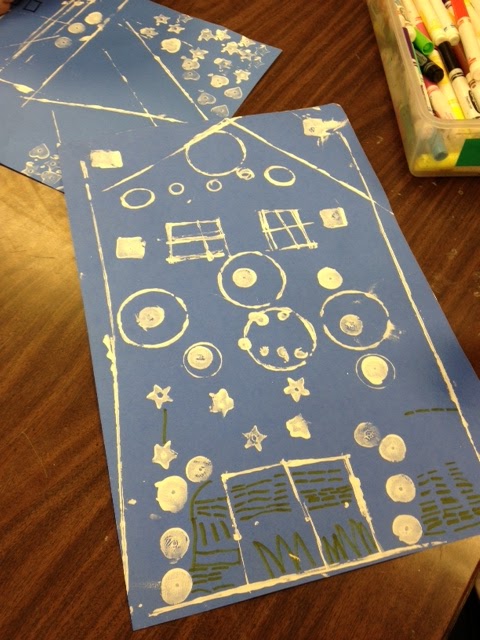
Kindergarten Blue Prints
What is an architect? What do they do?
Have you read Iggy Peck, Architect? It's a beautifully illustrated story about a boy and his dream to be an architect. Kindergarten students love the pictures and understand the message of the story.
Kindergarten students pretended they were architects and made Blue Prints using a stamping method. Check out this Mrs. Knight's Smartest Artists for this and many more wonderful art lessons.
Have you read Iggy Peck, Architect? It's a beautifully illustrated story about a boy and his dream to be an architect. Kindergarten students love the pictures and understand the message of the story.
Kindergarten students pretended they were architects and made Blue Prints using a stamping method. Check out this Mrs. Knight's Smartest Artists for this and many more wonderful art lessons.
Thursday, January 24, 2013
2nd grade Symmetrical Insect Prints
In order to understand the principle of art, Balance, 2nd graders looked at various art reproductions and discussed the difference between Symmetry and Asymmetry.
It's common to think of insects when discussing something balanced because insects are so symmetrical. Check out this video of an insect photographer who captures photographs of bugs up close and personal. Students were surprised to see the amount of color and detail.
We discussed common characteristics of insects, and students designed their own bug using lines, shapes, and colors. In order to create symmetry, students only drew half their bug and then monoprinted the other side.
It's common to think of insects when discussing something balanced because insects are so symmetrical. Check out this video of an insect photographer who captures photographs of bugs up close and personal. Students were surprised to see the amount of color and detail.
We discussed common characteristics of insects, and students designed their own bug using lines, shapes, and colors. In order to create symmetry, students only drew half their bug and then monoprinted the other side.
After cutting out the insects and gluing to a clean paper background, students created a word border by writing about their insect around the outside edge of the paper.
I think it's interesting how each insect is completely different and unique. The students really explored their own ideas and own personal artistic choices in this project.
1st grade House Sculptures
What is the difference between something flat and 3d? What do you call a 3d artwork? How can you turn something flat into something 3d?
These are all questions discussed with 1st graders in the past few weeks. Students know the difference between geometric and free-form shapes, as well as the difference between shapes and forms.
Students discussed the South African culture, Ndebele, who are famous for their brightly painted homes. Students identified patterns, lines, and shapes in the designs.
Students turned an ordinary paper lunch bag into a bright, bold, colorful sculpture inspired by the Ndebele people.
These are all questions discussed with 1st graders in the past few weeks. Students know the difference between geometric and free-form shapes, as well as the difference between shapes and forms.
Students discussed the South African culture, Ndebele, who are famous for their brightly painted homes. Students identified patterns, lines, and shapes in the designs.
Students turned an ordinary paper lunch bag into a bright, bold, colorful sculpture inspired by the Ndebele people.
Thursday, December 13, 2012
Aesthetic Discussions
3rd and 4th graders had some interesting discussions this week.
- Why is it important to look closely at an artwork?
- What influences your opinion? What influences your opinion about an artwork?
- What can we learn from looking at artwork?
The token response game is a classic way to get students to think about aesthetic issues and questions. Students assign "rewards" to different artworks and then defend their reasoning. Which artwork is your favorite? Which is worth the most money? Which took the longest to make? Which artwork would you give as a gift?
The Art Scavenger Hunt encourages students to look closer at artworks. What changes as we examine them further? Does your opinion change once you know more about it?
- Why is it important to look closely at an artwork?
- What influences your opinion? What influences your opinion about an artwork?
- What can we learn from looking at artwork?
The token response game is a classic way to get students to think about aesthetic issues and questions. Students assign "rewards" to different artworks and then defend their reasoning. Which artwork is your favorite? Which is worth the most money? Which took the longest to make? Which artwork would you give as a gift?
The Art Scavenger Hunt encourages students to look closer at artworks. What changes as we examine them further? Does your opinion change once you know more about it?
Thursday, December 6, 2012
Kindergarten Number Paintings
Jasper Johns is an American modern artist known for making prints of numbers and other common parts of pop culture. He was born in Georgia and grew up in South Carolina.
Kindergarten students discussed how numbers are important in our world and practiced drawing numbers and letters.
Students looked at various artwork and discussed the principal of art, Emphasis. What is the most important part of an artwork? What do you see first? How do artists create emphasis?
Can you see the sparkly part that students chose to emphasize?
Kindergarten students discussed how numbers are important in our world and practiced drawing numbers and letters.
Students looked at various artwork and discussed the principal of art, Emphasis. What is the most important part of an artwork? What do you see first? How do artists create emphasis?
Can you see the sparkly part that students chose to emphasize?
1st grade Landscapes
Thanks to The Crayon Lab for the lesson, 1st graders discussed the parts of a landscape and the artwork of Wolf Kahn. Students know vocabulary like Horizon Line and Depth. Students understand that artists show depth by making objects smaller and higher on the page.
Wolf Kahn's landscapes are very free and loose and certainly very colorful. 1st graders used liquid watercolors to brighten their landscapes with vivid colors.
Subscribe to:
Posts (Atom)